




Jeep 4x4 systems provide superior traction and clearance for heavy snowdrifts, unplowed rural roads, and severe slush due to higher ride height, dedicated low-range transfer cases, and mechanical locking options. Dodge all-wheel-drive (AWD) systems excel on icy highways and slick paved roads, utilizing automated front-axle disconnect and temperature-triggered engagement to deliver rapid traction on freezing rain while optimizing everyday fuel economy.
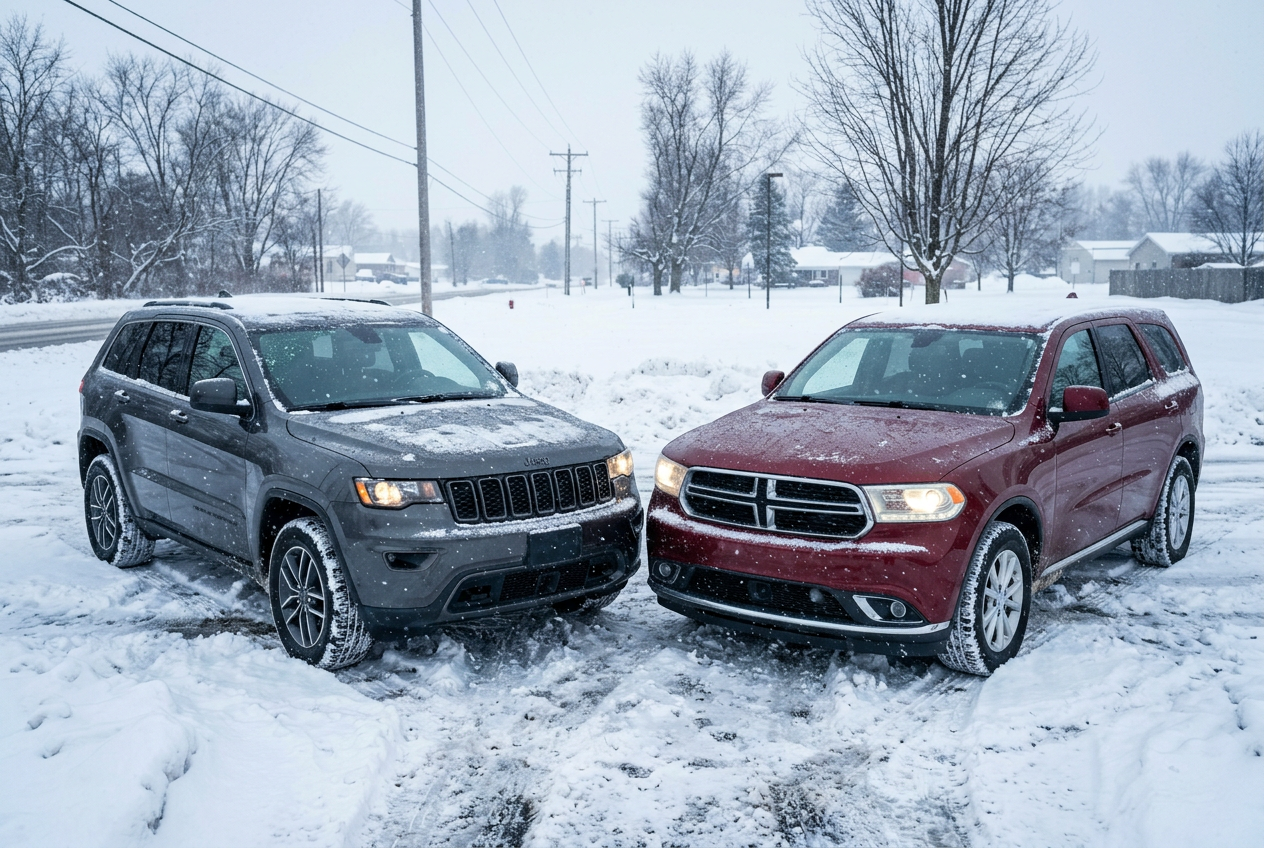
Winter driving across the flat farmland and open stretches surrounding Decatur presents distinct challenges. Snowdrifts frequently pile across rural county roads, while sub-freezing temperatures quickly coat asphalt in black ice. Selecting between a Jeep 4x4 and a Dodge AWD vehicle depends heavily on your daily driving routes and ground clearance needs.
Jeep vehicles are engineered with continuous off-road capability in mind. Models equipped with full-time or part-time four-wheel-drive systems utilize mechanical transfer cases that physically lock power between the front and rear axles. This mechanical bond ensures that engine torque is delivered evenly to both ends of the vehicle, making it easier to pull through heavy slush, unplowed driveways, and deep snowdrifts.
Dodge AWD vehicles, including performance crossovers and sedans, use an on-demand active coupling system. Under normal driving conditions on dry pavement, the system operates in rear-wheel drive to save fuel. When sensors detect low ambient temperatures or wheel slip, the system automatically engages the front axle to distribute power across all four wheels. Drivers seeking winter confidence can visit our Decatur showroom location at 1331 S 13th St, Decatur, IN 46733 or give our sales team a quick call at (260) 264-7970 to compare both drivetrains in person.
Table of Contents
- What Is the Main Difference Between Jeep 4x4 and Dodge AWD Systems in Snow and Freezing Rain?
- How Does Jeep Quadra-Trac II and Selec-Terrain Compare to Dodge Front-Axle Disconnect AWD?
- What Are the Risks of Driving in Deep Snow with Low Ground Clearance?
- How Does Dodge Durango AWD and Fuel Efficiency Compare to Jeep 4x4 and Ford Intelligent 4WD?
- Common Questions About Driving Jeep 4x4 and Dodge AWD on Winter Roads
- Test Drive Winter-Ready Jeep and Dodge Models in Decatur
What Is the Main Difference Between Jeep 4x4 and Dodge AWD Systems in Snow and Freezing Rain?
The primary mechanical difference between Jeep 4x4 and Dodge AWD lies in how each system manages torque distribution and axle engagement. Jeep 4x4 setups rely on active or mechanical two-speed transfer cases designed to lock torque split evenly between axles for deep snow, whereas Dodge AWD utilizes an automated clutch coupling that disconnects the front axle during light-duty driving and engages continuously when road temperatures drop.
On freezing rain and glaze ice, instantaneous system reaction time is critical. Dodge AWD systems feature an automated cold-temperature trigger. When ambient external temperatures fall near 37°F or when windshield wipers run continuously, the vehicle automatically engages all-wheel drive preemptively. This means all four wheels are powered before a tire ever touches a sheet of ice, providing instant stability when accelerating across slick bridge decks.
Jeep full-time systems, such as those found on the 2026 Jeep Grand Cherokee, continuously monitor tire slip using high-speed wheel sensors. If a single wheel loses grip on freezing rain, electronic throttle controls and brake differentials brake the slipping wheel while routing power to the tires with grip. On performance models like the 2026 Dodge Charger, selecting Wet/Snow mode forces a balanced 50/50 front-to-rear power split while calibrating traction control to soften throttle inputs, preventing sudden tire spin on ice.
Driver behavior remains the ultimate factor in winter safety. The Indiana Department of Transportation cautions that while four-wheel drive and all-wheel drive help a vehicle accelerate on snow or ice, four-wheel power does not shorten stopping distances or guarantee steering control after traction is broken. Drivers must still travel well below posted speed limits, increase braking distances, and brake early and gradually.
To keep your vehicle running smoothly through severe weather, drivers can order genuine OEM parts such as winter wiper blades and heavy-duty floor mats, or explore current Dodge incentives on AWD models.
How Does Jeep Quadra-Trac II and Selec-Terrain Compare to Dodge Front-Axle Disconnect AWD?
Jeep Quadra-Trac II uses an active two-speed transfer case with a variable clutch pack that can direct up to 100 percent of available torque to the single axle with the most grip, while Dodge front-axle disconnect AWD functions primarily as a fuel-saving rear-wheel-drive system until sensors trigger automated front-axle coupling.
The Quadra-Trac II® system available on the 2026 Jeep Grand Cherokee features a 2.72:1 low-range gear set. This low gear ratio allows drivers to crawl at controlled low speeds through heavy, packed snow without overheating transmission clutches. Paired with the Selec-Terrain® Traction Management System, drivers can turn a console dial to Snow mode. This single input recalibrates up to 12 individual vehicle systems:
- Adjusts engine throttle response to prevent aggressive torque spikes that break tire friction on ice.
- Modifies transmission shift schedules to start in second gear or upshift earlier for smoother acceleration.
- Establishes a torque split across the transfer case to maintain chassis balance.
- Optimizes electronic stability control and anti-lock braking sensitivity for slick surfaces.
Dodge front-axle disconnect AWD takes a different engineering approach focused on highway dynamic performance and overall efficiency. By physically uncoupling the front driveshaft at the front axle when full traction is available, the drivetrain eliminates internal friction and rotating mass. When sensors detect cold weather, rapid steering inputs, or rear-wheel slippage, an electromechanical actuator reconnects the front axle in a fraction of a second.
For drivers shopping for severe-weather confidence, exploring our certified pre-owned inventory provides access to factory-inspected Jeep and Dodge models equipped with these advanced drivetrain systems.
| Feature / Capability | Jeep Quadra-Trac II® 4x4 | Dodge Front-Axle Disconnect AWD |
|---|---|---|
| Primary Drive Orientation | Full-time active 4WD | Rear-wheel drive default (automated AWD) |
| Transfer Case Gearing | 2-speed with 2.72:1 low range | Single-speed active coupling case |
| Max Torque Transfer | Up to 100% to front or rear axle | Up to 50% to front axle |
| Low-Range Capability | Included for crawling deep drifts | Not available |
| Drive Mode Tuning | Selec-Terrain® (Auto, Snow, Sport, Sand/Mud, Rock) | Drive Modes (Auto, Wet/Snow, Sport) |
What Are the Risks of Driving in Deep Snow with Low Ground Clearance?
Driving in deep snow with insufficient ground clearance creates a severe risk of high-centering, a condition where snow packs beneath the vehicle floor pan and lifts the tires completely off the pavement, causing a total loss of traction regardless of how sophisticated the 4x4 or AWD system is.
Ground clearance dictates whether a vehicle rides over snow or pushes against it like a plow. When a vehicle with low ground clearance attempts to navigate unplowed drifts, snow accumulates against the front fascia, crossmembers, and suspension arms. As momentum slows, the vehicle compresses the snow beneath its belly. Once the weight of the vehicle is supported by hard-packed snow under the chassis rather than the tires, the wheels spin freely in the air.
Vehicle ride heights vary significantly across categories:
- 2026 Jeep Wrangler: Offers between 8 and 10 inches of ground clearance, easily straddling deep snowdrifts and heavy slush ruts.
- 2026 Jeep Grand Cherokee: Delivers roughly 8 to 10 inches of clearance when equipped with available air suspension.
- 2026 Dodge Durango: Provides approximately 8 inches of ground clearance, combining SUV ride height with aggressive AWD traction.
- Dodge AWD Sedans and Coupes: Ride between 5 and 6 inches off the ground, making them ideal for plowed roads and icy highways but vulnerable to unplowed farm roads.
Beyond high-centering, driving low-slung vehicles through deep snow can force icy slush into radiator intakes, pack engine bays, and damage underbody plastic shields. Salt-belt driving conditions also expose undercarriage components to heavy brine and road salt. Jeep SUVs combat this with stamped steel skid plates that shield steering components, transfer cases, and fuel tanks from frozen debris.
Before severe weather hits, dropping by our express maintenance lane allows our certified technicians to inspect tire tread depth, test battery cold-cranking amps, and check underbody protective shields.
How Does Dodge Durango AWD and Fuel Efficiency Compare to Jeep 4x4 and Ford Intelligent 4WD?
The Dodge Durango offers standard full-time AWD on HEMI V8 models and optional AWD on V6 trims, delivering exceptional highway stability and muscle power while achieving competitive fuel economy against full-time Jeep 4x4 systems and Ford Intelligent 4WD crossovers.
In the Dodge lineup, the 2026 Dodge Durango stands out as a high-capability three-row SUV. The Durango lineup structures its drivetrain options clearly across trims:
- Durango GT: Features a standard 3.6L Pentastar V6 engine paired with an 8-speed TorqueFlite® automatic transmission, with all-wheel drive available as an option.
- Durango R/T and R/T 392: Feature standard full-time AWD paired with powerful V8 engines, including the available 6.4L HEMI® V8 producing 475 horsepower.
- Durango SRT® Hellcat: Features standard full-time AWD with a dedicated Snow mode that sets a fixed 50/50 front-to-rear torque distribution to handle high-output power on slick surfaces.
When equipped with the Tow 'n Go package, the Durango GT HEMI V8 delivers a towing capacity of up to 8,700 lbs, making it a work-ready option for hauling trailers through winter weather.
Fuel economy during Midwestern winters is impacted by cold ambient air, extended idling, and mechanical drag. Dodge vehicles equipped with front-axle disconnect AWD reduce parasitic drag during highway cruising when AWD is disengaged, helping preserve fuel mileage during daily mixed commutes into Fort Wayne. By comparison, full-time 4x4 systems incur slightly higher mechanical resistance due to continuously rotating front driveshafts. For example, the 2026 Jeep Grand Cherokee with all-wheel drive achieves an EPA-rated 20 city / 25 hwy mpg while providing a robust 6,200-lb towing capacity.
Comparing Dodge AWD to Ford Intelligent 4WD reveals similar active monitoring strategies. The Ford Explorer utilizes sensors to predict wheel slip and adjust torque preemptively. However, the Durango combines its active AWD system with higher V8 towing thresholds and broad seating flexibility, featuring over 50 seating configurations and up to 85 cubic feet of cargo space.
Buyers considering an upgrade for the winter season can value your trade-in online to see how much equity they can apply toward a new AWD or 4x4 SUV.
Common Questions About Driving Jeep 4x4 and Dodge AWD on Winter Roads
Q: How do cold ambient temperatures affect tire pressure and winter traction in Jeep and Dodge vehicles?
Cold ambient air causes tire pressure to drop by approximately 1 to 2 pounds per square inch for every 10-degree drop in temperature. Underinflated tires alter the contact patch on snow and ice, which can degrade steering response and increase tread wear. Checking tire pressures weekly during winter ensures that electronic stability control and brake lock differentials receive accurate wheel-speed data.
Q: Do Dodge Charger and Durango AWD models require special winter driving procedures?
Dodge AWD models engage all-wheel drive automatically when ambient temperatures approach freezing or when wheel slip is detected, requiring no manual lever shifts from the driver. Selecting Wet/Snow mode on the drive mode screen adjusts throttle sensitivity and shift timing to help prevent wheel spin when accelerating from a complete stop on icy roads.
Q: Can Jeep 4x4 systems be left in 4WD Low while driving on paved snow-covered roads?
4WD Low engages lower gear ratios intended strictly for slow-speed crawling through deep snow, mud, or steep off-road terrain at speeds below 25 mph. Driving in 4WD Low on paved roads—even when snow-covered—causes severe drivetrain binding and potential transfer case damage during turns. Full-time 4WD High or 4H AUTO modes should always be used for normal winter driving on paved streets.
Q: How do electronic stability control and brake lock differentials work together on icy roads?
Electronic stability control monitors wheel speed, steering angle, and vehicle yaw to detect skid conditions, applying individual brakes to keep the vehicle pointed in the driver's intended direction. Brake lock differentials work alongside stability control by applying hydraulic brake pressure to a spinning wheel on ice, instantly transferring torque across the axle to the opposite tire that retains grip.
Q: What winter prep should I perform on my Jeep or Dodge before the first snowstorm?
Preparing a vehicle for winter involves inspecting tire tread depth, testing the 12-volt battery's cold-cranking power, topping off winter-spec windshield washer fluid, and checking rubber door seals. To make buying and maintaining a vehicle simple, customers can review our home delivery process for sales convenience, learn about our dealership history and commitment to community service, or complete an online credit application to secure financing approval before visiting.
Test Drive Winter-Ready Jeep and Dodge Models in Decatur
Navigating Indiana winter roads with complete confidence comes down to selecting the right drivetrain for your specific driving routine. Whether you require the rugged ground clearance and low-range crawling capability of a Jeep 4x4 or the automated efficiency and swift ice reaction of a Dodge AWD system, Tom Kelley Chrysler Dodge Jeep Ram has the vehicle lineup to keep your family moving safely.
Our experienced team is ready to walk you through transfer case options, demonstrate Selec-Terrain® drive modes, and help you compare SUV cargo space on our showroom floor. You can explore our new Dodge Durango showroom inventory online, or visit us in person at 1331 S 13th St in Decatur.
Stop by to visit our Decatur showroom today, or call our team directly at (260) 264-7970 to schedule a winter test drive tailored to your family's needs.