




Qualifying businesses can deduct up to 100% of the purchase price of eligible 2026 Ram work trucks in the year they are acquired and put into service, rather than depreciating them over multiple years. For tax years beginning in 2026, the federal Section 179 maximum deduction is $2,560,000, phasing out dollar-for-dollar once total qualifying equipment purchases exceed $4,090,000. To qualify, a vehicle must be purchased or financed, put into active business use by December 31, and driven more than 50% for commercial operations.
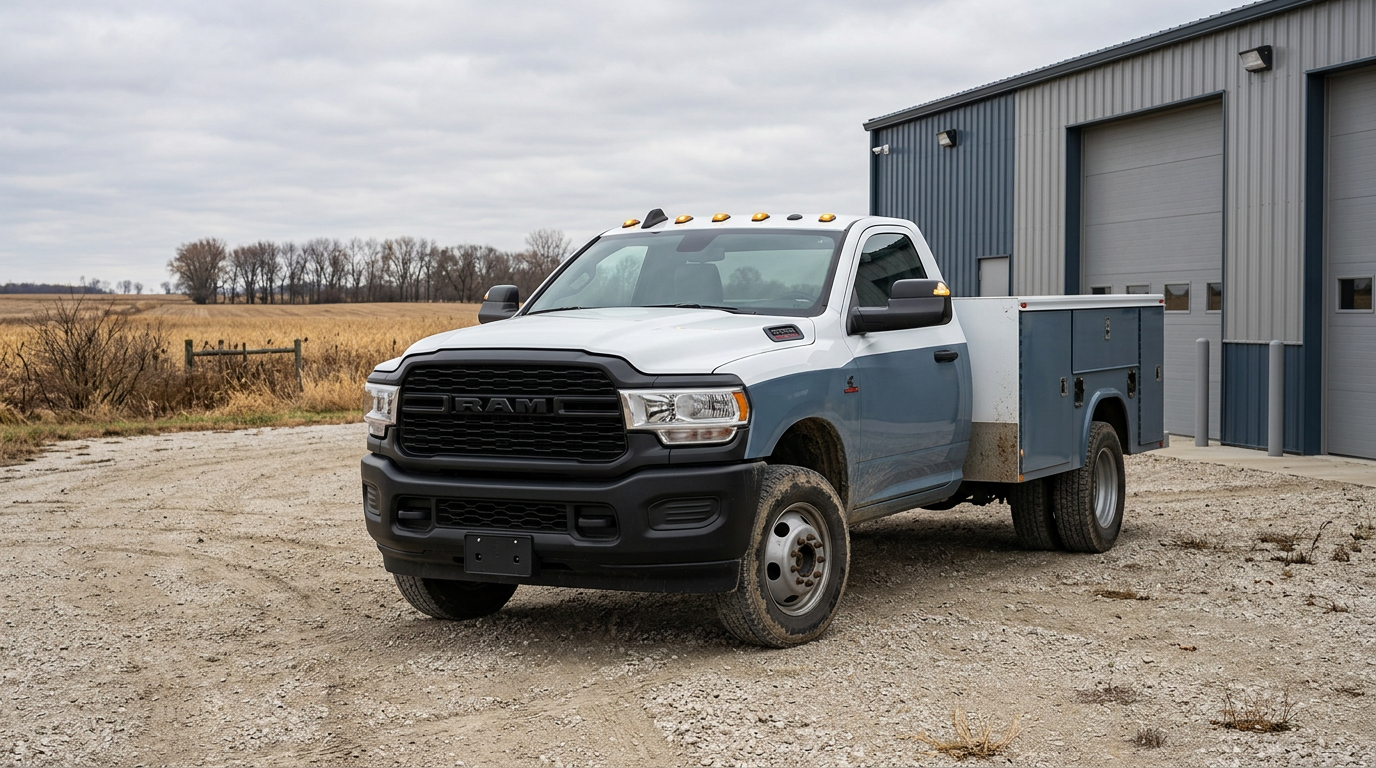
Commercial operations across the fertile farmland surrounding Decatur rely on durable machinery that earns its keep immediately. Internal Revenue Code Section 179 is designed to help trade contractors, agricultural outfits, and commercial fleets accelerate their return on equipment investments. Instead of writing off a percentage of a truck's value over five years, business owners can expense the full acquisition cost on their 2026 federal tax return.
Federal tax law distinguishes vehicles by Gross Vehicle Weight Rating (GVWR) and commercial configuration. Heavy-duty commercial trucks with a GVWR above 6,000 pounds that feature dedicated cargo beds, service bodies, or chassis-mounted equipment avoid standard passenger car caps. That allows local operators to deduct up to the full purchase price against taxable business income.
Planning these acquisitions before the tax year closes gives business owners control over their operating expenses. If you want to review available inventory or plan an addition to your fleet, you can give our commercial sales team a quick call or use our showroom address to map out a visit.
Table of Contents
- Which Ram Work Trucks Qualify for the Full Section 179 Deduction?
- Does Adding a Commercial Utility Bed or Dump Body Impact Section 179 Eligibility?
- How Do State Tax Rules Handle Section 179 and Bonus Depreciation?
- Can Commercial Fleet Incentives and Year-End Placed-in-Service Deadlines Be Combined?
- Common Questions About Section 179 Deductions for Ram Commercial Trucks
- Put a Qualified Ram Work Truck to Work at Tom Kelley Chrysler Dodge Jeep Ram
Which Ram Work Trucks Qualify for the Full Section 179 Deduction?
Every Ram 2500, Ram 3500, and chassis-cab model qualifies for the full Section 179 write-off because their Gross Vehicle Weight Ratings exceed 6,000 pounds and they serve as dedicated heavy-duty commercial equipment. The Ram 1500 also qualifies when configured above 6,000 pounds GVWR, though specific IRS limitations can apply to passenger-oriented configurations that lack dedicated commercial cargo capacity.
Heavy commercial duty requires proven capability. In the heavy-duty lineup, Ram provides exceptional work-ready capability across every category:
- Ram 2500 pickups deliver a maximum towing capacity of 20,000 pounds and up to 4,580 pounds of payload depending on configuration.
- Ram 2500 4x4 models equipped with the available high-output 6.7-liter Cummins turbo-diesel I6 provide a maximum towing capacity of 19,900 pounds and 3,590 pounds of payload.
- Ram 3500 heavy-duty trucks handle massive demands with up to 36,610 pounds of towing capacity and 7,590 pounds of payload.
- Ram commercial chassis-cab models, available in 3500, 4500, and 5500 platforms, deliver bare-frame utility ready for dump beds, crane bodies, and custom flatbeds.
Light-duty pickups also serve critical business roles. J.D. Power reports that the 2026 Ram 1500 ranked highest in the large light-duty pickup segment in its 2026 Vehicle Dependability Study. In safety evaluations, J.D. Powerâs 2026 Ram 1500 review notes a four-star overall NHTSA safety rating, while the truck offers comfortable seating, a spacious cargo bed, and intuitive infotainment with easy smartphone integration. For light-duty commercial haulers, vehicles with a GVWR between 6,000 and 14,000 pounds that lack an eight-foot bed or commercial cargo partition may face the federal sport utility vehicle limitation, which is capped at $32,000 for 2026. Businesses transporting field crews can also inspect passenger movers like the new Chrysler Pacifica, which carries its own specific passenger vehicle write-off schedule.
â
Does Adding a Commercial Utility Bed or Dump Body Impact Section 179 Eligibility?
Installing a commercial utility bed, flatbed, or dump body does not diminish Section 179 eligibility; instead, it expands the deduction because the cost of the permanently attached upfit is added directly to the truck's total depreciable basis. Because chassis-mounted upfits transform the vehicle into a specialized commercial tool, the entire combined package qualifies as tangible business property.
Commercial upfits include service capsules, utility bodies, dump boxes, platform stakes, crane mounts, and snow removal hardware. When our dealership coordinates an upfit on a 2026 Ram 3500, 4500, or 5500 chassis cab, the truck invoice and equipment additions combine into a single capitalized business acquisition. For companies operating along the Wabash River in Bluffton, where agricultural support and manufacturing trades require heavy payload durability, these specialized builds provide write-offs that reflect the complete, ready-to-work vehicle.
The upfit must be permanently installed and placed in service within the same tax year as the chassis to be included in that year's Section 179 total.
â
How Do State Tax Rules Handle Section 179 and Bonus Depreciation?
Indiana and Ohio state tax laws both allow businesses to benefit from Section 179 deductions, but each state enforces specific adjustments and add-back requirements for federal bonus depreciation. While federal law permits immediate expensing through Section 179 and bonus depreciation under Internal Revenue Code Section 168(k), state tax filings diverge when processing these accelerated deductions.
State-specific guidelines function with clear structural distinctions:
- Indiana Tax Treatment: Indiana generally conforms to federal Section 179 expense limits, allowing business owners to take the primary write-off on their state return without a direct add-back. However, Indiana disallows 100% federal bonus depreciation, requiring taxpayers to add back the bonus amount and recover it over regular state depreciation schedules.
- Ohio Tax Treatment: Ohio couples with Section 179 expensing under defined state limits, but requires a mandatory add-back of 5/6 (or 2/3 under certain small business circumstances) of federal bonus depreciation. Ohio taxpayers then deduct the added-back portion in equal 1/5 increments over the following five tax years.
These distinct state rules make vehicle selection and tax classification critical for regional commercial operations. Selecting well-maintained commercial transportation, such as vehicles from our certified pre-owned inventory, allows businesses to acquire reliable equipment with clear provenance while coordinating precise depreciation schedules with their CPA.
â
Can Commercial Fleet Incentives and Year-End Placed-in-Service Deadlines Be Combined?
Commercial fleet incentives and manufacturer programs may be available alongside Section 179 deductions; contact the dealership for current details. The Section 179 write-off applies to the net capitalized purchase cost of the truck after all eligible commercial discounts are deducted from the transaction price.
To claim any deduction for the current tax year, the truck must meet the strict "placed-in-service" standard by 11:59 PM on December 31. Simply signing purchase agreements, making down payments, or receiving an invoice before midnight does not satisfy IRS requirements. The vehicle must be physically delivered, titled, registered, and ready to perform commercial work before the calendar year closes.
Business owners can maximize their capital efficiency by pairing available manufacturer incentives with accelerated tax write-offs. When updating company vehicles, you can review current Chrysler commercial incentives or explore rugged performance options through our current Dodge incentives. If your business plans to retire aging work trucks, our commercial sales team can help you value your trade-in to reduce the financed balance on your replacement commercial fleet.
â
Common Questions About Section 179 Deductions for Ram Commercial Trucks
Q: What percentage of business driving is required to claim a Section 179 deduction?
A vehicle must be used more than 50% for qualified business purposes during the tax year it is placed in service to be eligible for Section 179 expensing. If commercial use meets or exceeds this threshold, the allowable deduction is calculated based on the precise percentage of business use. For example, a heavy-duty Ram 2500 driven 80% for commercial jobsites and 20% for personal travel qualifies to deduct 80% of its eligible purchase basis under Section 179.
Q: Can a business claim Section 179 on both financed and cash-purchased work trucks?
Yes, Section 179 applies whether a commercial vehicle is purchased with cash, acquired through an equipment loan, or financed through conventional commercial vehicle lending. The IRS allows the full qualifying deduction in the tax year the asset is placed in service, even if the business makes monthly loan payments over multiple subsequent years. Buyers ready to structure commercial financing can begin by submitting a full credit application with our dealership team.
Q: Are pre-owned Ram trucks eligible for Section 179 tax deductions?
Pre-owned commercial trucks qualify for Section 179 deductions provided they are new to your business operations and meet all standard commercial weight and business-use requirements. The vehicle cannot have been previously owned or used by your company, a parent firm, or a related individual. The truck must also be purchased in an arm's-length commercial transaction and put into service before the December 31 year-end deadline.
Q: How does vehicle delivery timing affect Section 179 eligibility?
Delivery timing is vital because an asset must be physically accessible and operable for business use before midnight on December 31 of the applicable tax year. If a truck remains in transit from an upfitter or the manufacturer on January 1, it cannot be expensed on the previous year's tax return. Companies purchasing late in the fourth quarter can explore options like having our staff deliver the vehicle directly to your business driveway to secure timely delivery.
Q: Are federal clean vehicle tax credits available for newly purchased commercial trucks?
The federal IRC Section 30D, Section 25E, and Section 45W commercial clean vehicle tax credits were officially terminated under Public Law 119-21 for any vehicles acquired after September 30, 2025. Businesses purchasing commercial work trucks today cannot claim federal electric vehicle credits. Current tax planning should focus on Section 179 expensing, state-level commercial programs, and standard MACRS depreciation structures.
â
Put a Qualified Ram Work Truck to Work at Tom Kelley Chrysler Dodge Jeep Ram
Equipping your business with a durable 2026 Ram work truck strengthens your daily towing capacity, increases payload performance, and provides significant year-end tax advantages. Whether you require a versatile Ram 1500 for jobsite oversight, a heavy-duty Ram 2500 or 3500 for massive equipment hauling, or a customized 4500 or 5500 chassis cab, our team is prepared to get your vehicle on the road before the December 31 deadline.
Take the next step in preparing your fleet for the upcoming year. Connect directly with our commercial vehicle department by placing a quick call to discuss work-ready configurations, or drop a pin for our Decatur showroom address to review our commercial lineup in person.
Keep Your Vehicle Running Strong
Keep your vehicle performing at its best with our service team:
© 2026 Tom Kelley Chrysler Dodge Jeep Ram. All rights reserved.